|
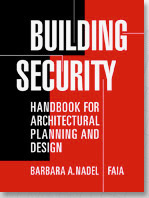
Building Security: Handbook for Architectural Planning and Design is found in over 350 public, university, and government libraries worldwide,from the U.S., Canada, Singapore, China, and Hong Kong, to Europe, the Middle East, and Australia.
Building Security has been featured in more than 75 global media outlets, including: AEC Asia News, Architect’s Newspaper, Architectural Record, www.ArchNewsNow.com, Buildings, Chicago Tribune, Design-Build DATELINE, Deutsches Architektenblatt (Germany), Homeland Security Television, La Libre Belgique (Belgium), Newsday, Security Advisor Middle East, Urban Land, Wall Street Journal Radio, and many others.
LAW ENFORCEMENT
“Some buildings are properly designed and built, eventually becoming classics or historical monuments. Too many buildings, especially government buildings, are poorly designed, use outdated technologies, and quickly become deteriorated old hulks. In today’s political climate, with today’s many complex workplace issues, it is imperative that buildings incorporate the best possible design and security technologies. We owe our employees, and we owe future generations, nothing less. Barbara A. Nadel’s new book provides an interesting perspective for this growing area of concern.”
– William J. Bratton, former Chief of Police, Los Angeles Police Department, and former New York City Police Commissioner
“At the Nation’s founding, Jefferson appreciated the important relationship between architecture and democracy. It is critical now more than ever for architects to get right the often conflicting demands of freedom and security to ensure that democratic ideals are not lost in the steel and stone of our edifices.”
– Raymond W. Kelly, New York City Police Commissioner
“Given the ever looming specter of terrorism and other threats to the assets and well being of businesses and building owners alike, today’s architect must now approach building design paying equal consideration to aesthetics, functionality, and security. Ms. Nadel has written an insightful, sweeping book on security design that is a must-read for architects, landlords, security consultants and anyone else tasked with or interested in ensuring security and averting catastrophic loss.”
– Bernard B. Kerik, Former New York City Police Commissioner
BOOK REVIEWS
“Nadel’s integrated approach to building security, disaster planning, and emergency response is timely, and results in a handy reference for a wide variety of security issues. Structured around the lessons of September 11th and other benchmark events (thoroughly outlined in the introductory chapter), this title is logically organized into six subject areas: transparent (i.e., unobtrusive) security, planning and design, engineering, construction, technology and materials, and codes and liabilities.
The planning and design section is the most robust, with chapters focused on the security concerns of particular classes of buildings (educational, religious, commercial, etc.). Numerous tables, checklists, figures, and black-and-white photographs clarify and summarize the text. Chapters conclude with a short bibliography and a list of Internet resources; some provide a glossary and/or related standards. Crime prevention, workplace violence, and natural disasters are also given substantive treatment. The index (with see also references) provides sufficient access to the material. An excellent single-volume written by building design, construction, and management experts for fellow professionals. Highly recommended.
– Choice, The American Library Association
"Dedicating her work to the victims of 9-11, author Barbara A. Nadel, a well-known architect and advocate of security planning, has prepared a strategic reference guide that chronicles and advances the state of security knowledge. With the input of more than 50 industry professionals, the book presents numerous security perspectives on the design or renovation of various building types and related security upgrades of facilities and systems.
The centerpiece of Nadel's six-part work is the second part, which consists of 17 chapters on security planning and design elements for various types of facilities, including sports complexes, convention centers, commercial high rises, hospitals, courthouses, museums, and retail stores. The rest of the book concentrates on protective design of structures, building and security system technologies, construction, building codes, and liability issues. Other easy-to-understand chapters cover engineering principles and costs relating to the design and protection of critical electrical, mechanical, and fire-protection systems. Nadel has done her due diligence, in the organization and presentation of materials, and in her refreshing proactive approach to building security."
– Security Management
"Building Security is the last word in security design, the definitive 21st-century reference on security, technology, building operations, and disaster planning. It includes a model for determining the potential cost impacts of incorporating nine building security elements into a design."
– AIArchitect
"This book is a solid compendium of information, an authoritative resource fit for the architect, engineer, specialty consultant, and the building owner, facility manager, public official, educator, and student."
– Oculus
"This weighty reference focuses on architectural issues in security design, and pays attention to landscape and perimeter security."
– Landscape Architecture
"Building Security delivers what its title promises. Three themes underlie the multitude of disciplines and building types in the book: learning from the past (lessons learned are included in each chapter and summarized in the first); integrating approaches (critical since building designers and managers are rarely the same people); and planning carefully for each situation."
– Planning Magazine
|
"The first place architects and security practitioners should go to for security design."
– Former Security and Safety Director, Major International Organization
"The last word in security design."
– AIArchitect
|





 ©2024 Barbara Nadel Architect



